
Marziale United States flag New York State flag Lewis County, New York flag

Hudson River School

The Hudson River School was a mid-19th-century American art movement made by a group of landscape painters whose aesthetic vision was influenced by Romanticism.[1] Early on, the paintings typically depicted the Hudson River Valley and the surrounding area, including the Catskill, Adirondack, and White Mountains.[1] Works by second-generation artists expanded to include other locales in New England, the Maritimes, the Western United States, and South America.[1] The school of landscape painters flourished between 1825 and 1870, which was often called the "native", "American", or "New York" school.[1] New York City was the center of it, many members had studios in the Tenth Street Studio Building in Greenwich Village.[27] The term Hudson River School is thought to have been coined by the New York Tribune art critic Clarence Cook or by landscape painter Homer Dodge Martin.[12] The name appeared in print in 1879, it was initially used during the 1870s disparagingly, as the style had gone out of favor after the plein-air Barbizon School had come into vogue among American patrons and collectors.[27]

Hudson River School paintings reflect three themes of America in the 19th century: discovery, exploration, and settlement.[15] They also depict the American landscape as a pastoral setting, where human beings and nature coexist peacefully.[1] Hudson River School landscapes are characterized by their realistic, detailed, and sometimes idealized portrayal of nature, often juxtaposing peaceful agriculture and the remaining wilderness which was fast disappearing from the Hudson Valley just as it was coming to be appreciated for its qualities of ruggedness and sublimity.[17] In general, Hudson River School artists believed that nature in the form of the American landscape was a reflection of God, though they varied in the depth of their religious conviction.[49] They were inspired by European masters such as Claude Lorrain, John Constable, and J. M. W. Turner.[1] Several painters were members of the Düsseldorf School of Painting, and they were educated by German Paul Weber.[12] A prominent element of the Hudson River School was its themes of nationalism, nature, and property.[1] Adherents of the movement also tended to be suspicious of the economic and technological development of the age.[22][33]

Thomas Cole (February 1, 1801 – February 11, 1848) was an English-born American artist who founded the Hudson River School art movement.[54][31][37] He took a steamboat up the Hudson in the autumn of 1825, stopping first at West Point then at Catskill landing.[1] He hiked west, high into the eastern Catskill Mountains of New York to paint the first landscapes of the area.[1] The first review of his work appeared in the New York Evening Post on November 22, 1825.[50] Cole was from England and the brilliant autumn colors in the American landscape inspired him.[23] His paintings are typically allegoric and often depict small figures or structures set against moody and evocative natural landscapes.[2] They are usually escapist, framing the New World as a natural eden contrasting with the smog-filled cityscapes of Industrial Revolution-era Britain, in which he grew up.[35][32] His works, often seen as conservative, criticize the contemporary trends of industrialism, urbanism, and westward expansion.[36] Cole spent the years 1829 to 1832 and 1841 to 1842 abroad, mainly in England and Italy.[29] His close friend Asher Brown Durand became a prominent figure in the school.[56] Church studied with Cole from 1844 to 1846, where he learned Cole's technique of sketching from nature and later developing an idealized, finished composition; Cole's influence is particularly notable in Church's early paintings.[21] Thomas Cole died at Catskill on February 11, 1848, of pleurisy.[52]

The second generation of Hudson River School artists emerged after Cole's premature death in 1848; its members included Cole's prize pupil Frederic Edwin Church, John Frederick Kensett, and Sanford Robinson Gifford.[1] Works by artists of this second generation are often described as examples of Luminism.[1] Kensett, Gifford, and Church were also among the founders of the Metropolitan Museum of Art in New York City.[46] Most of the finest works of the second generation were painted between 1855 and 1875.[1] Artists such as Frederic Edwin Church and Albert Bierstadt were celebrities then.[1] They were both influenced by the Düsseldorf school of painting, and Bierstadt had studied in that city for several years.[1] Thousands of people would pay 25 cents per person to view paintings such as Niagara and The Icebergs.[57][47] The epic size of these landscapes was unexampled in earlier American painting and reminded Americans of the vast, untamed, and magnificent wilderness areas in their country.[1] This was the period of settlement in the American West, preservation of national parks, and establishment of green city parks.[1]

Hudson River School art has had minor periods of a resurgence in popularity.[1] The school gained interest after World War I, likely due to nationalist attitudes.[1] Interest declined until the 1960s, and the regrowth of the Hudson Valley has spurred further interest in the movement.[39] Historic house museums and other sites dedicated to the Hudson River School include Olana State Historic Site in Hudson, New York, the Thomas Cole National Historic Site in the town of Catskill, the Newington-Cropsey Foundation's historic house museum, art gallery, and research library in Hastings-on-Hudson, New York, and the John D. Barrow Art Gallery in the village of Skaneateles, New York.[1]

Every sentence above is quoted word for word from the Wikipedia articles Hudson River School and Thomas Cole, under CC BY-SA 4.0.
Paintings

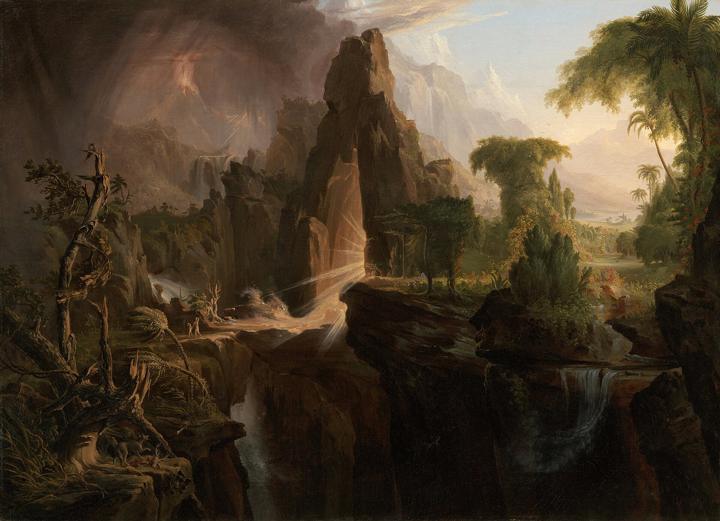
  • Thomas Cole, Expulsion from the Garden of Eden, 1828

    Expulsion from the Garden of Eden. Thomas Cole, 1828. Museum of Fine Arts, Boston. Cole signed it “T Cole” on the cliff at lower left.[70]
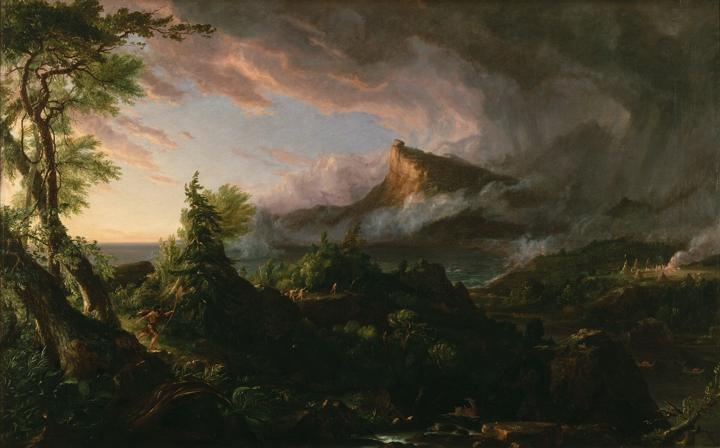
  • Thomas Cole, The Course of Empire: The Savage State, 1833–1836 series

    The Course of Empire: The Savage State. Thomas Cole, 1833–1836 series. New-York Historical Society. One of five paintings of the rise and fall of an imaginary city in one river valley; a boulder on a crag marks the same place in every scene.[68][33]
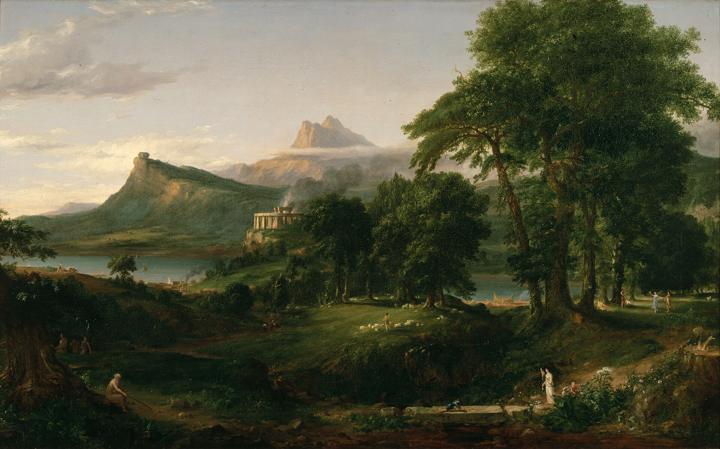
  • Thomas Cole, The Course of Empire: The Arcadian or Pastoral State, 1833–1836 series

    The Course of Empire: The Arcadian or Pastoral State. Thomas Cole, 1833–1836 series. New-York Historical Society. One of five paintings of the rise and fall of an imaginary city in one river valley; a boulder on a crag marks the same place in every scene.[68][33]
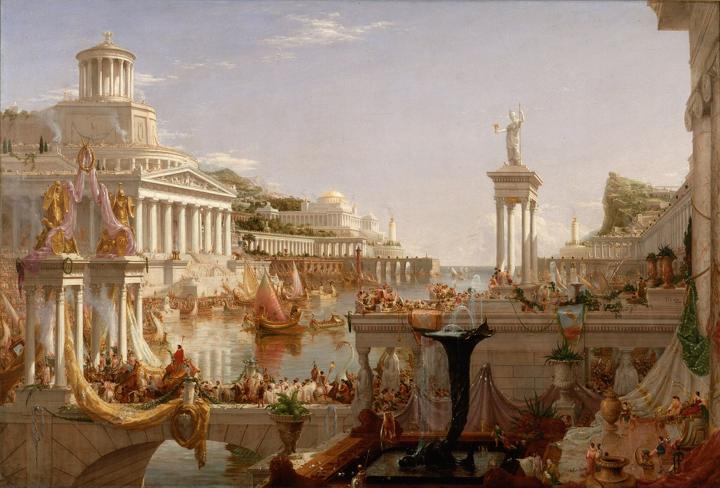
  • Thomas Cole, The Course of Empire: Consummation, 1833–1836 series

    The Course of Empire: Consummation. Thomas Cole, 1833–1836 series. New-York Historical Society. One of five paintings of the rise and fall of an imaginary city in one river valley; a boulder on a crag marks the same place in every scene.[68][33]
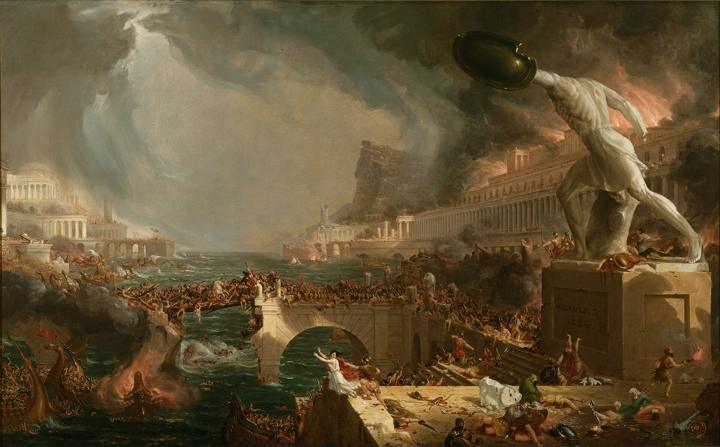
  • Thomas Cole, The Course of Empire: Destruction, 1833–1836 series

    The Course of Empire: Destruction. Thomas Cole, 1833–1836 series. New-York Historical Society. One of five paintings of the rise and fall of an imaginary city in one river valley; a boulder on a crag marks the same place in every scene.[68][33]
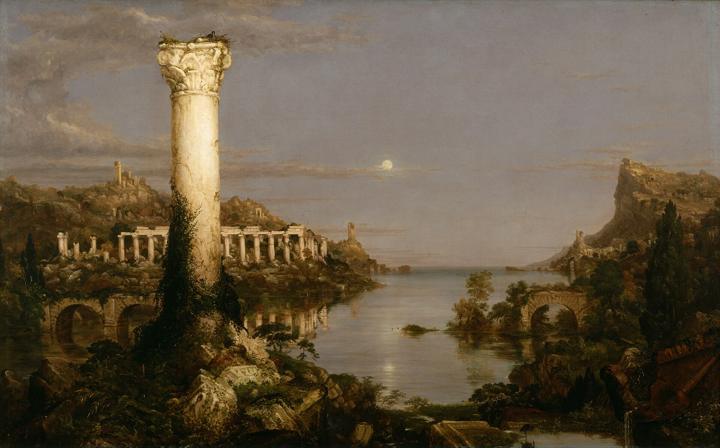
  • Thomas Cole, The Course of Empire: Desolation, 1833–1836 series

    The Course of Empire: Desolation. Thomas Cole, 1833–1836 series. New-York Historical Society. One of five paintings of the rise and fall of an imaginary city in one river valley; a boulder on a crag marks the same place in every scene.[68][33]
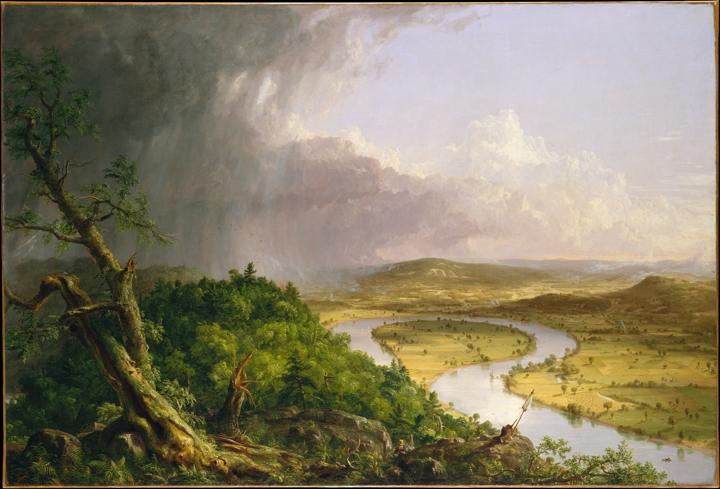
  • Thomas Cole, View from Mount Holyoke, Northampton, Massachusetts, after a Thunderstorm (The Oxbow), 1836

    View from Mount Holyoke, Northampton, Massachusetts, after a Thunderstorm (The Oxbow). Thomas Cole, 1836. The Metropolitan Museum of Art, New York. A panorama of the Connecticut River valley just after a storm, often read as wilderness meeting civilization.[67]
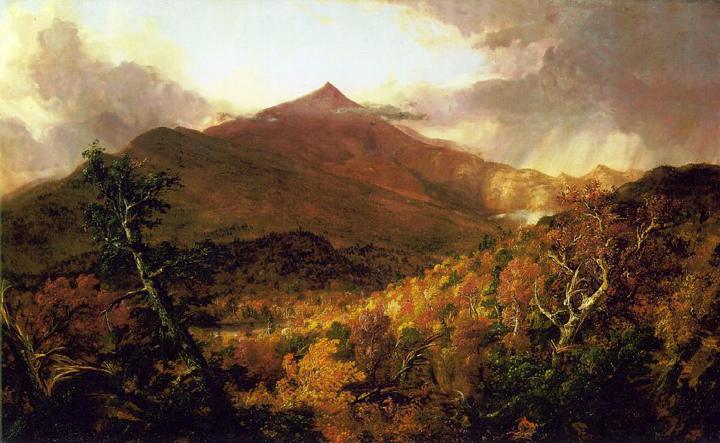
  • Thomas Cole, View of Schroon Mountain, Essex County, New York, After a Storm, 1838

    View of Schroon Mountain, Essex County, New York, After a Storm. Thomas Cole, 1838. Cleveland Museum of Art. An Adirondack peak after a storm.[71]
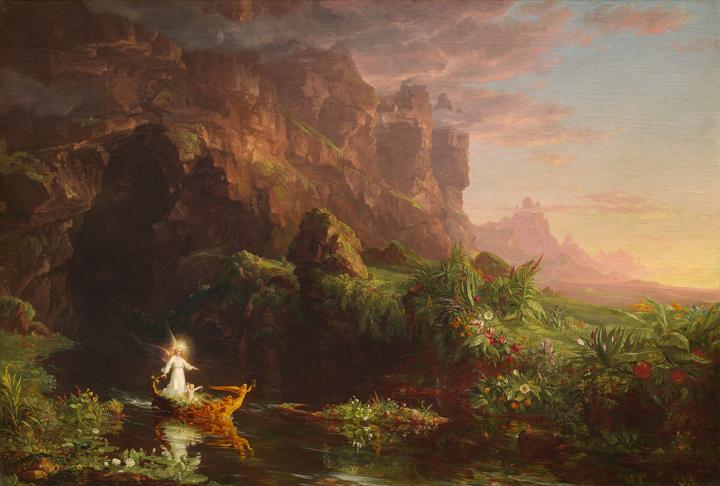
  • Thomas Cole, The Voyage of Life: Childhood, 1842

    The Voyage of Life: Childhood. Thomas Cole, 1842. National Gallery of Art, Washington. One of four paintings that follow a voyager down the River of Life with a guardian angel. Cole painted the series in 1840 (Munson-Williams-Proctor Arts Institute, Utica) and repeated it with small changes in 1842 (National Gallery of Art). The infant glides out of a dark cave into a green landscape.[69][33]
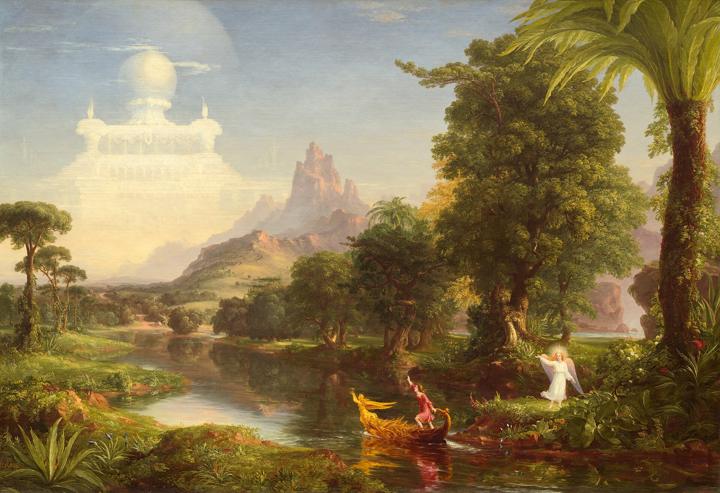
  • Thomas Cole, The Voyage of Life: Youth, 1842

    The Voyage of Life: Youth. Thomas Cole, 1842. National Gallery of Art, Washington. One of four paintings that follow a voyager down the River of Life with a guardian angel. Cole painted the series in 1840 (Munson-Williams-Proctor Arts Institute, Utica) and repeated it with small changes in 1842 (National Gallery of Art). The youth takes the helm and steers for a castle in the sky.[69][33]
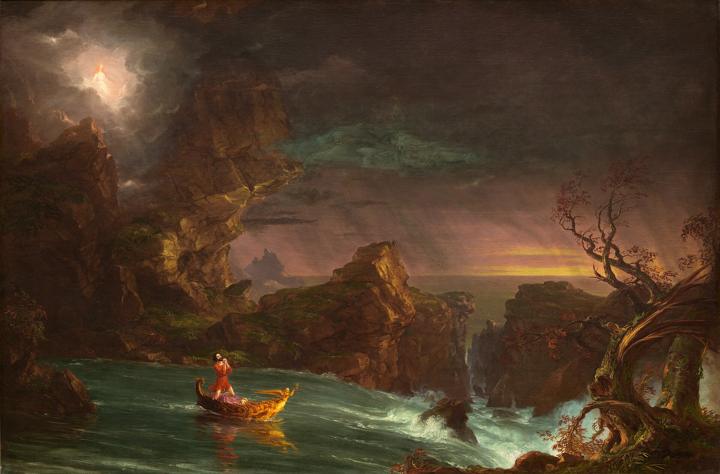
  • Thomas Cole, The Voyage of Life: Manhood, 1842

    The Voyage of Life: Manhood. Thomas Cole, 1842. National Gallery of Art, Washington. One of four paintings that follow a voyager down the River of Life with a guardian angel. Cole painted the series in 1840 (Munson-Williams-Proctor Arts Institute, Utica) and repeated it with small changes in 1842 (National Gallery of Art). The man relies on prayer to get through rough water.[69][33]
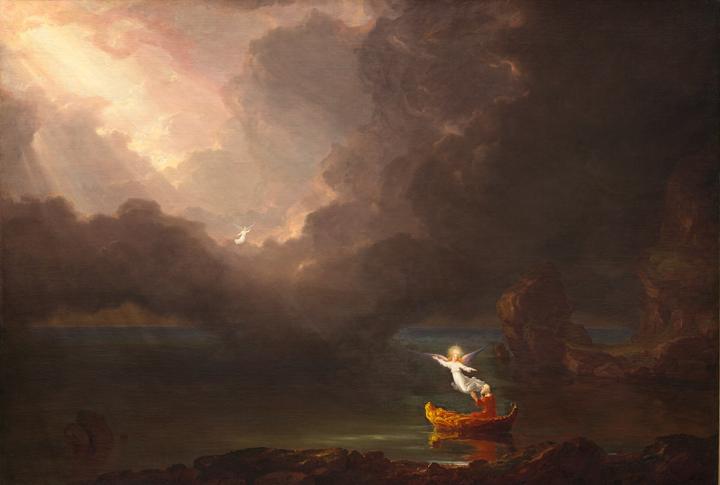
  • Thomas Cole, The Voyage of Life: Old Age, 1842

    The Voyage of Life: Old Age. Thomas Cole, 1842. National Gallery of Art, Washington. One of four paintings that follow a voyager down the River of Life with a guardian angel. Cole painted the series in 1840 (Munson-Williams-Proctor Arts Institute, Utica) and repeated it with small changes in 1842 (National Gallery of Art). The angel guides the old man across the waters of eternity.[69][33]
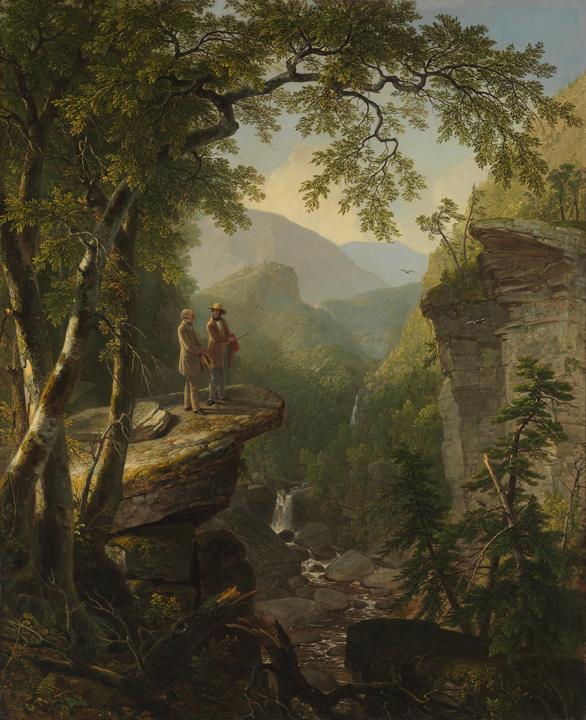
  • Asher Brown Durand, Kindred Spirits, 1849

    Kindred Spirits. Asher Brown Durand, 1849. Crystal Bridges Museum of American Art, Bentonville. Thomas Cole, who had died in 1848, and the poet William Cullen Bryant in the Catskills: an idealized memory built from Kaaterskill Clove, not a literal view.[72]
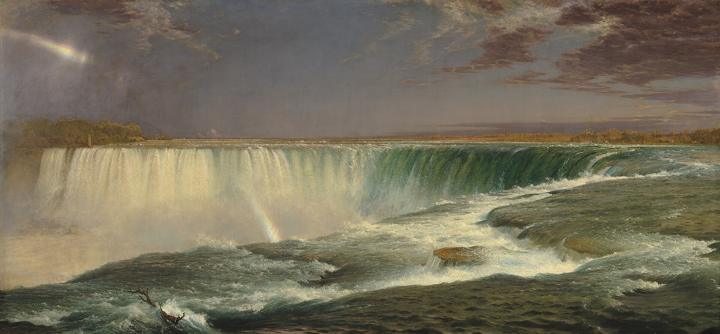
  • Frederic Edwin Church, Niagara, 1857

    Niagara. Frederic Edwin Church, 1857. National Gallery of Art, Washington (formerly Corcoran Gallery of Art). The Horseshoe Falls. It confirmed Church as the leading American landscape painter, and thousands paid 25 cents to see it.[73][57]
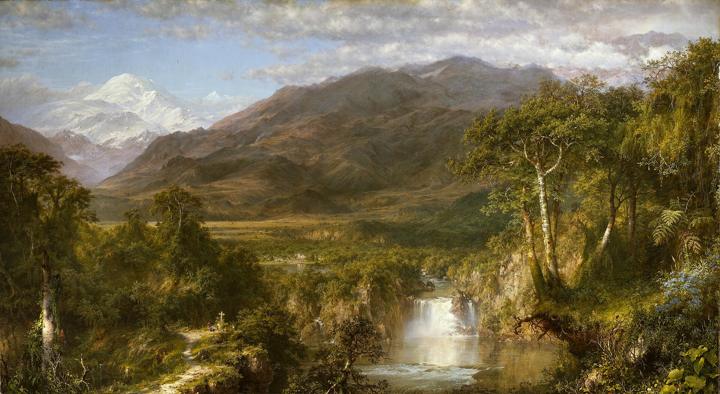
  • Frederic Edwin Church, The Heart of the Andes, 1859

    The Heart of the Andes. Frederic Edwin Church, 1859. The Metropolitan Museum of Art, New York. An idealized Andes view, more than five feet high and almost ten feet wide. Its 1859 New York showing was a sensation; visitors waited in line and paid 25 cents.[74]
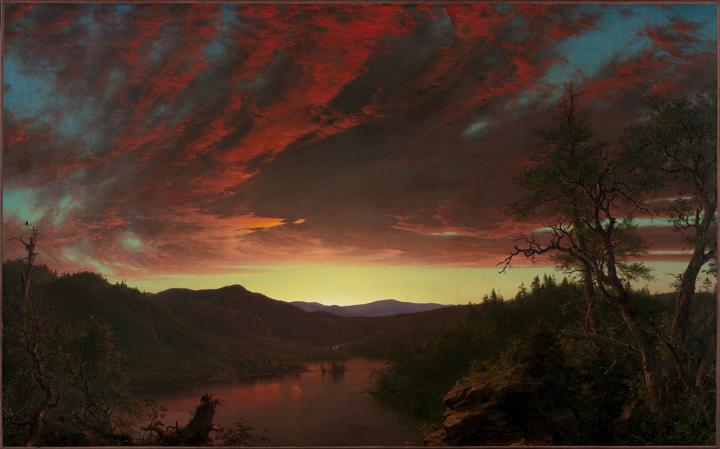
  • Frederic Edwin Church, Twilight in the Wilderness, 1860

    Twilight in the Wilderness. Frederic Edwin Church, 1860. Cleveland Museum of Art. Northeastern woods under a setting sun that colors the clouds. John K. Howat calls it “one of his finest ever.”[75]
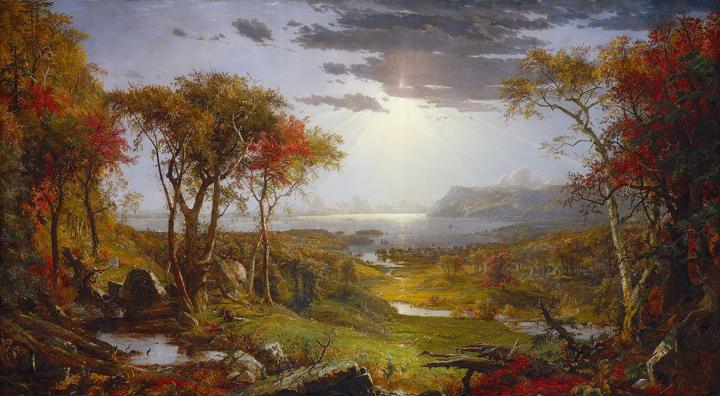
  • Jasper Francis Cropsey, Autumn – On the Hudson River, 1860

    Autumn – On the Hudson River. Jasper Francis Cropsey, 1860. National Gallery of Art, Washington.
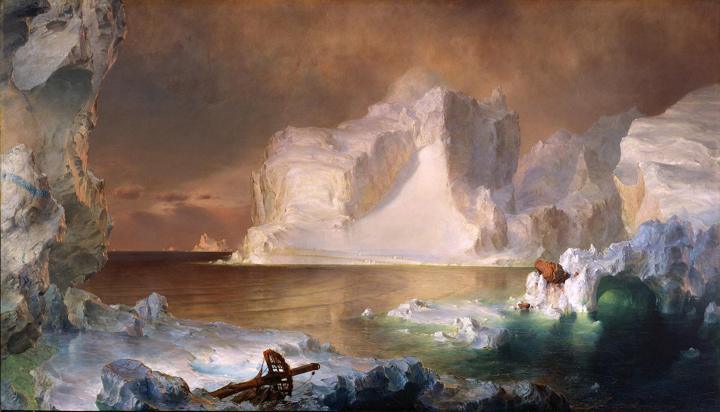
  • Frederic Edwin Church, The Icebergs, 1861

    The Icebergs. Frederic Edwin Church, 1861. Dallas Museum of Art. From Church's 1859 voyage off Newfoundland and Labrador; 1.64 by 2.85 m. Shown alone in New York in 1861 for 25 cents, the year the Civil War began.[76][47]
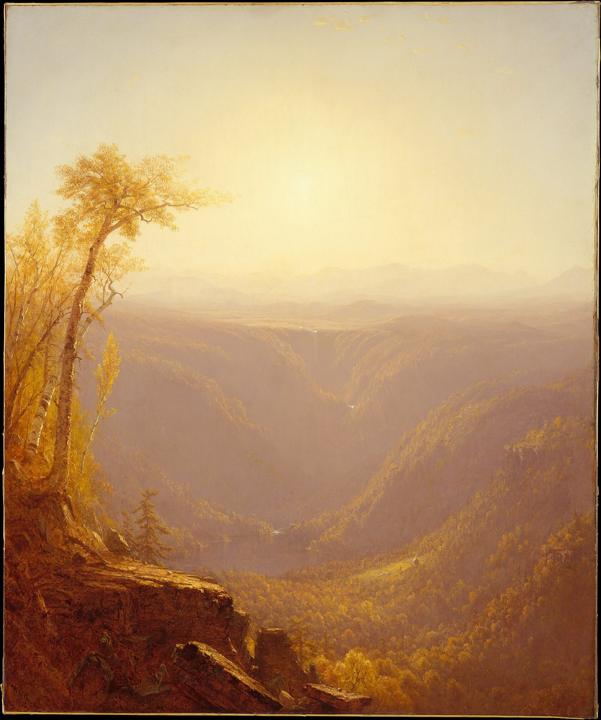
  • Sanford Robinson Gifford, A Gorge in the Mountains (Kauterskill Clove), 1862

    A Gorge in the Mountains (Kauterskill Clove). Sanford Robinson Gifford, 1862. The Metropolitan Museum of Art, New York.
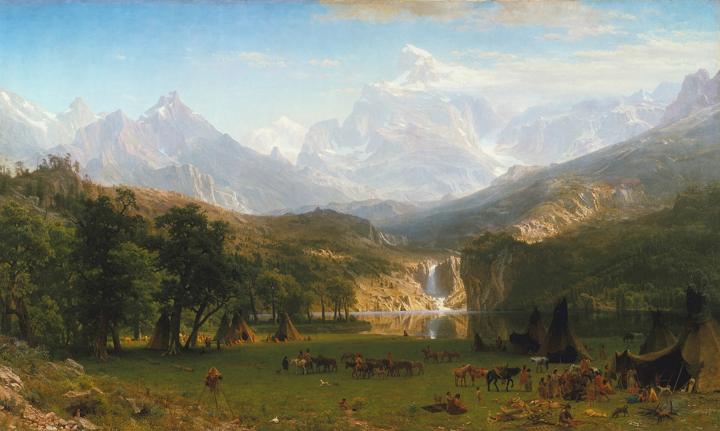
  • Albert Bierstadt, The Rocky Mountains, Lander's Peak, 1863

    The Rocky Mountains, Lander's Peak. Albert Bierstadt, 1863. The Metropolitan Museum of Art, New York. From sketches on Frederick W. Lander's 1859 survey: the Wyoming Range with a Native American camp. It sold in 1865 for $25,000.[77]
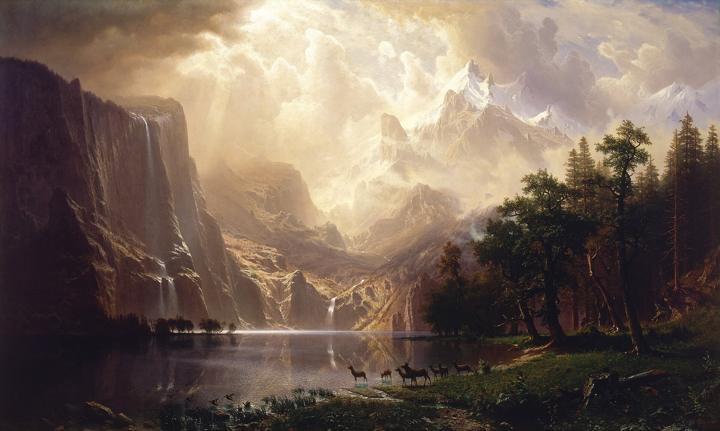
  • Albert Bierstadt, Among the Sierra Nevada, California, 1868

    Among the Sierra Nevada, California. Albert Bierstadt, 1868. Smithsonian American Art Museum, Washington. Painted in Bierstadt's studio in Rome and shown across Europe, where it stirred interest in moving to the United States.[78]
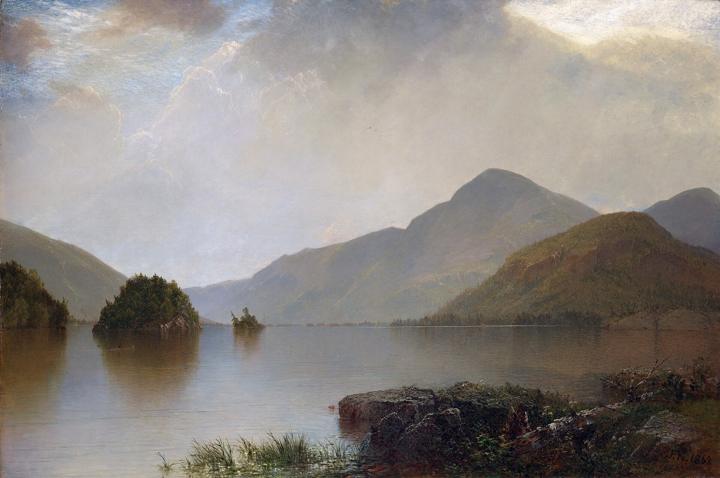
  • John Frederick Kensett, Lake George, 1869

    Lake George. John Frederick Kensett, 1869. The Metropolitan Museum of Art, New York.
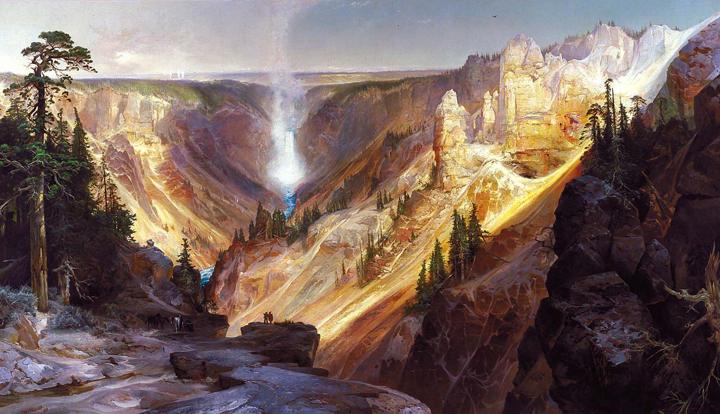
  • Thomas Moran, The Grand Canyon of the Yellowstone, 1872

    The Grand Canyon of the Yellowstone. Thomas Moran, 1872. Smithsonian American Art Museum, Washington (lent by the U.S. Department of the Interior).

Artists

  • Thomas Cole (1801–1848). Founder of the school. Born in Bolton, England; came to the United States in 1818 and settled in Catskill, New York, in 1825. Largely self-taught. Cedar Grove, his home, became a National Historic Site in 1999.[29][20][23][53]
  • Asher Brown Durand (1796–1886). Engraver and painter; Cole's close friend and a leading figure of the school.[79][56]
  • Frederic Edwin Church (1826–1900). Cole's pupil from 1844 to 1846. Painted vast scenes and showed single pictures to paying crowds; a founder of the Metropolitan Museum of Art.[21][80][46]
  • Albert Bierstadt (1830–1902). Born in Solingen, Germany; trained in Düsseldorf. His Rocky Mountain, Sierra Nevada and Yosemite scenes made him famous.[81]
  • Sanford Robinson Gifford (1823–1880). A leading second-generation painter and Luminist, known for light and soft atmosphere; a founder of the Metropolitan Museum of Art.[82][46]
  • Jasper Francis Cropsey (1823–1900). Architect and painter. His house and gallery in Hastings-on-Hudson are open to visitors.[83][40]
  • John Frederick Kensett (1816–1872). Cooler colors and quiet scenes of New England and New York; associated with Luminism; a founder of the Metropolitan Museum of Art.[84]
  • Thomas Moran (1837–1926). Illustrator for Scribner's Monthly who became a leading painter of the American West, above all the Rocky Mountains.[85]
  • Susie M. Barstow (1836–1923). Mountain climber who painted the Catskills and the White Mountains.[42][86]
  • Eliza Pratt Greatorex (1819–1897). Irish-born; the second woman elected to the National Academy of Design.[42][88]
  • Julie Hart Beers (1835–1913). Led sketching trips in the Hudson Valley, then kept a New York studio with her daughters.[42][87]
  • Emily Cole (1843–1913). Thomas Cole's daughter; a botanical artist in watercolor and on porcelain.[45][44]

Sources

  1. "Hudson River School." Wikipedia. Open
  2. "Thomas Cole." Wikipedia. Open
  3. "The Hudson River School." Heilbrunn Timeline of Art History. The Metropolitan Museum of Art. Open
  4. Cedar Grove: the Thomas Cole National Historic Site, Catskill, New York. Open
  5. Cole, Thomas. "Essay on American Scenery." The American Monthly Magazine 1, no. 1 (January 1836): 1–12. Full text with an introduction: "American Scenery: Thomas Cole vs NASA," Museum Zero, 2018. Open
  6. Cole, Thomas. Journal, 1834–1848. Digitized by the New York State Library. Open
  7. Thomas A. Cole Papers, 1821–1863. Finding aid, New York State Library, Manuscripts and Special Collections. Open
  8. Thomas Cole Collection. Finding aid, Albany Institute of History & Art. Archived copy
  9. Noble, Louis Legrand. The Life and Works of Thomas Cole. New York: Sheldon, Blakeman, 1856. Open
  10. Cole, Thomas, and Daniel Wadsworth. The Correspondence of Thomas Cole and Daniel Wadsworth. Hartford: Connecticut Historical Society, 1983. Print only.
  11. Cole, Thomas. Readings of his works. LibriVox. Open
  12. Howat, John K., et al. American Paradise: The World of the Hudson River School. New York: The Metropolitan Museum of Art and Harry N. Abrams, 1987. Open
  13. Art and the Empire City: New York, 1825–1861. New York: The Metropolitan Museum of Art, 2000. Open
  14. Avery, Kevin J., and Franklin Kelly, eds. Hudson River School Visions: The Landscapes of Sanford R. Gifford. New York: The Metropolitan Museum of Art, 2003. Open
  15. Kornhauser, Elizabeth Mankin, Amy Ellis, and Maureen Miesmer. Hudson River School: Masterworks from the Wadsworth Atheneum Museum of Art. Hartford: Wadsworth Atheneum, 2003. Print only.
  16. Kornhauser, Elizabeth Mankin, and Tim Barringer. Thomas Cole’s Journey: Atlantic Crossings. Exhibition, The Metropolitan Museum of Art, 2018. Open
  17. The Panoramic River: The Hudson and the Thames. Yonkers: Hudson River Museum, 2013. Open
  18. Wilmerding, John. American Light: The Luminist Movement, 1850–1875. Washington: National Gallery of Art, 1980. Print only.
  19. Studies on Thomas Cole. Baltimore Museum of Art, Annual II. Baltimore, 1967. Print only.
  20. Truettner, William H., and Alan Wallach. Thomas Cole: Landscape into History. New Haven: Yale University Press, 1994. Print only.
  21. Howat, John K. Frederic Church. New Haven: Yale University Press, 2005. Print only.
  22. Miller, Angela. The Empire of the Eye: Landscape Representation and American Cultural Politics, 1825–1875. Ithaca: Cornell University Press, 1993. Print only.
  23. O’Toole, Judith H. Different Views in Hudson River School Painting. New York: Columbia University Press, 2005. Open
  24. Ferber, Linda S. The Hudson River School: Nature and the American Vision. New York: New-York Historical Society, 2009. Print only.
  25. Sullivan, Mark W. The Hudson River School: An Annotated Bibliography. Metuchen, NJ: Scarecrow Press, 1991. Open
  26. White, Mark Andrew. Progress on the Land: Industry and the American Landscape Tradition. Oklahoma City: Melton Art Reference Library, 2002. Print only.
  27. Jackson, Kenneth T., ed. The Encyclopedia of New York City. New Haven: Yale University Press, 1995. Print only.
  28. Weidman, Jeffrey. Artists in Ohio, 1787–1900: A Biographical Dictionary. Kent, OH: Kent State University Press, 2000. Open
  29. "Cole, Thomas." Encyclopædia Britannica, 11th ed., 1911. Open
  30. "Thomas Doughty." Encyclopædia Britannica. Open
  31. Lovejoy, David S. "American Painting in Early Nineteenth-Century Gift Books." American Quarterly 7, no. 4 (Winter 1955). Open
  32. Parry, Ellwood C., III. "Thomas Cole’s The Hunter’s Return." The American Art Journal 17, no. 3 (1985): 2–17. Open
  33. Brophy, Alfred L. "Property and Progress: Antebellum Landscape Art and Property Law." McGeorge Law Review 40 (2009). Open
  34. Effmann, Elise. "Thomas Cole’s View of Fort Putnam." The Magazine Antiques, November 2004, 154–59. Archived copy
  35. Kornhauser, Elizabeth. "Re-examining Thomas Cole." The Magazine Antiques, January 8, 2018. Open
  36. Cotter, Holland. "Thomas Cole, American Moralist." The New York Times, March 15, 2018. Open
  37. Genocchio, Benjamin. "In an Untamed Wilderness, Finding the Serene." The New York Times, June 18, 2006. Open
  38. Schweber, Nate. "Unknown Thomas Cole Paintings Found at His Home." The New York Times, July 1, 2015. Open
  39. Zimmer, William. "Hudson River School Just Keeps on Rolling." The New York Times, October 17, 1999. Open
  40. Hershenson, Roberta. "Work Is in Dispute, but Cropsey’s Home Is Open." The New York Times, November 7, 1999. Open
  41. Smee, Sebastian. "The Artist Who Made America Look Like a Promised Land." Review of Glorious Country by Victoria Johnson. The New Yorker, May 11, 2026. Open
  42. Dobrzynski, Judith H. "The Grand Women Artists of the Hudson River School." Smithsonian. Archived copy
  43. "Remember the Ladies: Women Artists of the Hudson River School." Resource Library, Traditional Fine Arts Organization. Open
  44. Cascone, Sarah. "Emily Cole, Daughter of Hudson River School Icon, Shines in Overdue Museum Show." Artnet News, April 16, 2025. Open
  45. "The Art of Emily Cole." Thomas Cole National Historic Site, 2019. Open
  46. Avery, Kevin J. "Frederic Edwin Church." Heilbrunn Timeline of Art History. The Metropolitan Museum of Art. Open
  47. Potter, Russell A. Review of The Voyage of the Icebergs: Frederic Edwin Church’s Arctic Masterpiece. Rhode Island College. Archived copy
  48. Allaback, Sarah. 19th Century Painters: Hudson River School. Hudson River Valley National Heritage Area, 2006. Archived copy
  49. "The Hudson River School: Nationalism, Romanticism, and the Celebration of the American Landscape." Virginia Tech, Department of History. Archived copy
  50. Boyle, Alexander. "Thomas Cole (1801–1848): The Dawn of the Hudson River School." Hamilton Auction Galleries. Archived copy
  51. Rickey, Frederick. "Robert W. Weir (1803–1889)." United States Military Academy. Archived copy
  52. "Biography of Thomas Cole." Thomas Cole National Historic Site. Archived copy
  53. "Cedar Grove History." Thomas Cole National Historic Site. Archived copy
  54. Thomas Cole. Artist page. National Gallery of Art, Washington. Open
  55. Hudson River School collection. Wadsworth Atheneum Museum of Art, Hartford. Open
  56. Asher B. Durand. Smithsonian American Art Museum. Archived copy
  57. Frederic Edwin Church, Niagara, 1857. Corcoran Gallery of Art (now in the National Gallery of Art). Archived copy
  58. Works by Thomas Cole. Cincinnati Art Museum. Archived copy
  59. Selected works. Reynolda House Museum of American Art, Winston-Salem. Archived copy
  60. White Mountain paintings by Thomas Cole. White Mountain Art. Archived copy
  61. Thomas Cole, View of Fort Putnam. Hamilton Auction Galleries (image). Archived copy
  62. "The Hudson River School." Exhibition. American Art Gallery. Open
  63. "Hudson River School." National Park Service, museum exhibit overview. Archived copy
  64. Thomas Cole, The Oxbow, 1836. Video lesson. Khan Academy. Open
  65. Thomas Cole, Expulsion from the Garden of Eden, 1828. Video lesson. Khan Academy. Open
  66. Exhibit at the Amon Carter Museum of American Art, Fort Worth, Texas. Print only.
  67. "The Oxbow." Wikipedia. Open
  68. "The Course of Empire (paintings)." Wikipedia. Open
  69. "The Voyage of Life." Wikipedia. Open
  70. "Expulsion from the Garden of Eden (Cole)." Wikipedia. Open
  71. "List of paintings by Thomas Cole." Wikipedia. Open
  72. "Kindred Spirits (painting)." Wikipedia. Open
  73. "Niagara (Frederic Edwin Church)." Wikipedia. Open
  74. "The Heart of the Andes." Wikipedia. Open
  75. "Twilight in the Wilderness." Wikipedia. Open
  76. "The Icebergs." Wikipedia. Open
  77. "The Rocky Mountains, Lander's Peak." Wikipedia. Open
  78. "Among the Sierra Nevada, California." Wikipedia. Open
  79. "Asher Brown Durand." Wikipedia. Open
  80. "Frederic Edwin Church." Wikipedia. Open
  81. "Albert Bierstadt." Wikipedia. Open
  82. "Sanford Robinson Gifford." Wikipedia. Open
  83. "Jasper Francis Cropsey." Wikipedia. Open
  84. "John Frederick Kensett." Wikipedia. Open
  85. "Thomas Moran." Wikipedia. Open
  86. "Susie M. Barstow." Wikipedia. Open
  87. "Julie Hart Beers." Wikipedia. Open
  88. "Eliza Pratt Greatorex." Wikipedia. Open
  89. "Luminism (American art style)." Wikipedia. Open